
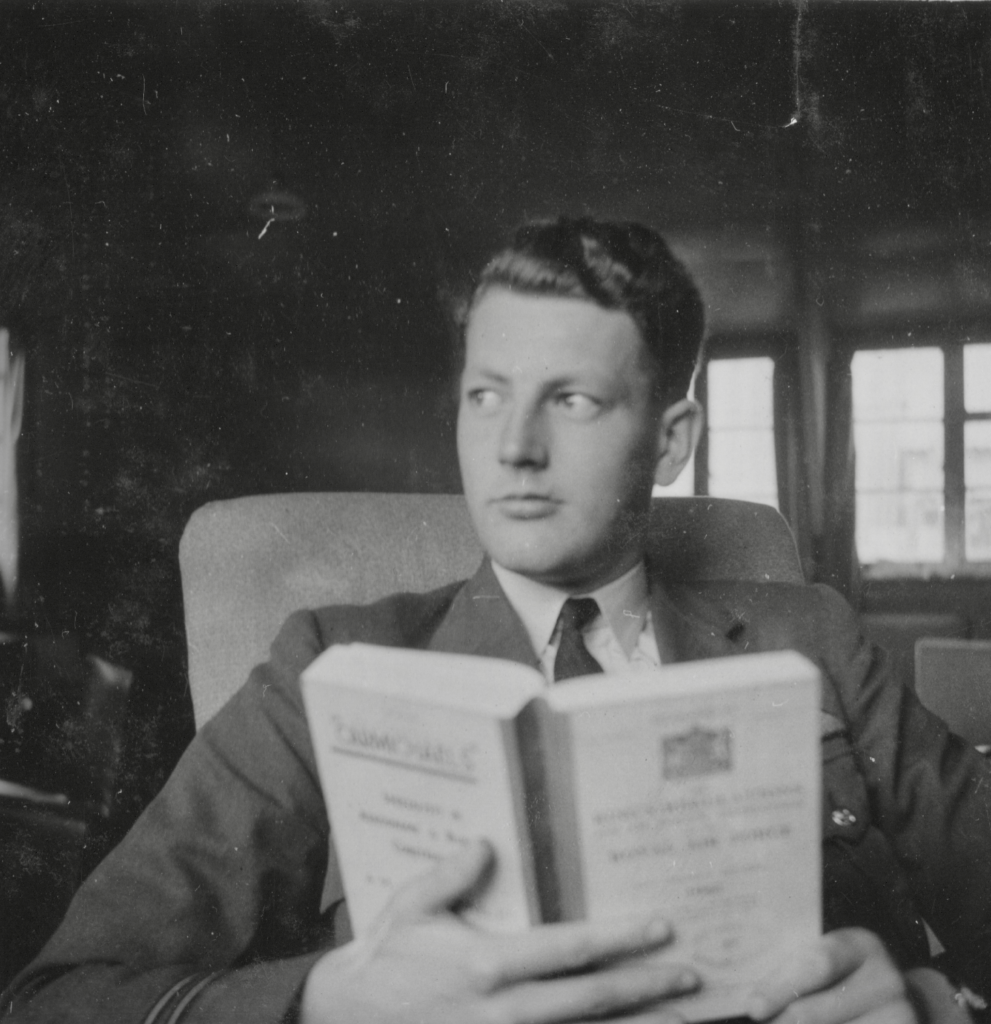
F/Lt J F D ‘Tim’ Elkington RAF
197 Squadron RAF, 31 January – 9 September 1943
F/Lt ‘Tim’ Elkington RAF (Svc. No. 44184) joined 197 Squadron RAF, then forming at RAF Drem, East Lothian, in early February 1943, and remained with the Squadron until September 1943. Already an experienced and successful pilot, Tim Elkington’s time with 197 Squadron was relatively sedate compared with his earlier service, and probably a welcome change.
John Francis Durham Elkington, known to all as ‘Tim’, entered RAF College Cranwell in September 1939, passing out with a permanent commission on July 14th, 1940. The next day, he joined No. 1 Squadron RAF at RAF Northolt and was immediately in action in the opening phase of the Battle of Britain. Flying a Hurricane fighter, Tim Elkington shot down a Me BF 109 on August 15th. The following day, he was on patrol over Portsmouth when his section ran into a large formation of enemy fighters near Selsey Bill. The Hurricanes became separated during the engagement, and Elkington was attacked from the rear whilst pursuing a lone Bf 109. The Hurricane’s starboard fuel tank was hit, and the aircraft burst into flames. Slightly injured, he was forced to bail out off the coast; his wingman repeatedly flew close by so that the slipstream from his own Hurricane would draw the parachute over towards land. After recovering from his injuries, Elkington rejoined No. 1 Squadron, which had moved to RAF Wittering, on 1st October 1940 and went straight back into action. He was credited with destroying a Junkers Ju88 on the 9th October and shared in the destruction of a Dornier Do215 on the 27th.
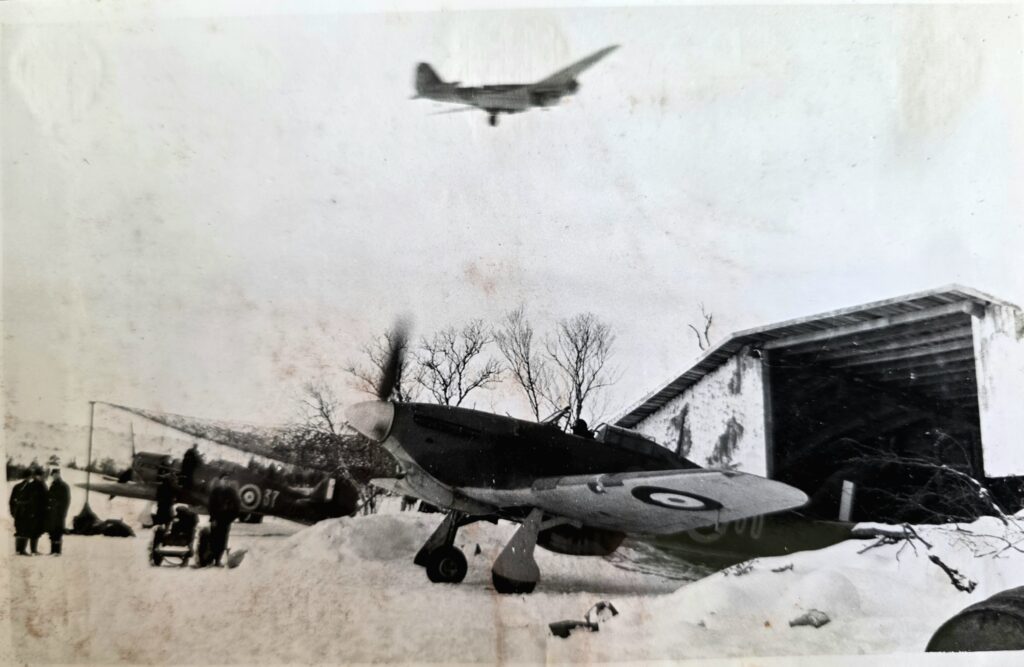
In late July 1941, F/O Tim Elkington joined 134 Squadron RAF, then forming at RAF Leconfield for service in Russia. The Squadron embarked on HMS Argus on 12th August and on 7th September flew off the carrier to the airfield at Vaenga, near Murmansk. During September and early October 1941, 134 Squadron took part in bomber escorts and airfield defence. In mid-October, the Squadron began training Russian pilots on the Hurricanes, which were handed over to the Russians at the end of the month. Whilst in Russia, Elkington shared in the destruction of another Junkers Ju88.
In mid-November 1941, 134 Squadron’s pilots began the journey home, first making their way in three minesweepers to Archangel, then sailing from there in HMS Berwick on 1st December 1941.
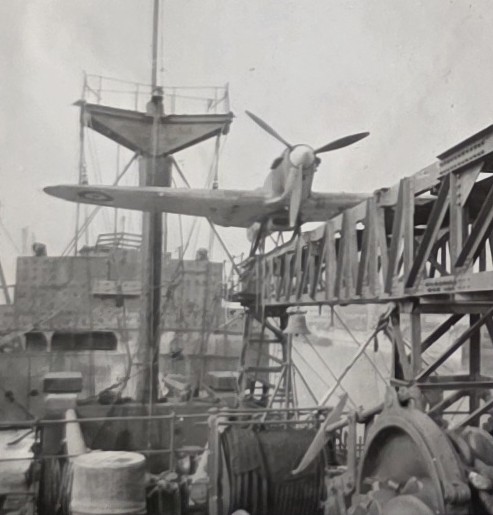
In April 1942, Tim Elkington joined the Merchant Ship Fighter Unit (MSFU), flying converted Hurricanes carried by CAM (Catapult Aircraft Merchant) ships, which escorted the trans-Atlantic and Arctic convoys. Whenever a German reconnaissance aircraft was sighted, the “Hurricat” (a modified Hurricane) would be catapulted from the deck of the ship to carry out an intercept. On return, the pilot either bailed out or ditched alongside the CAM ship. Tim Elkington completed one round trip from Liverpool to Halifax, Canada in the MV Eastern City, but was not called into action.
On returning from his maritime adventures, F/O Tim Elkington joined 539 Squadron RAF at RAF Acklington. 539 Squadron was a specialised ‘Turbinlite’ night-fighter squadron equipped with a mix of radar- and searchlight- equipped Douglas Havocs and Hurricane fighters, which enjoyed little success. When 539 Squadron was disbanded in January 1943, Elkington was posted to the newly-formed 197 Squadron at RAF Drem, equipped with Typhoons.
Elkington joined 197 Squadron just before the squadron completed its operational training and moved to RAF Tangmere, West Sussex, at the end of March 1943. There, 197 Squadron flew defensive patrols and offensive bomber escort missions throughout the summer months of 1943. For the recently promoted F/Lt Elkington, however, the ‘powers-that-be’ were to dictate that he was to spend quite some time away from the Squadron on various attachments and courses intended to groom him for command positions. In early March, F/Lt Elkington, whilst still at RAF Drem, was attached to the Directing Staff for Exercise SPARTAN, the first field exercise to trial the use of mobile airfields and bomb-equipped Typhoons, known as ‘Bombphoons’. A foretaste of what was to come for all the Typhoon squadrons as the war progressed, his experiences were doubtless of great interest to his fellow pilots in 197 Squadron, which was, at that time, a purely cannon-equipped fighter squadron. Thereafter, in May/June, F/Lt Elkington completed a three-week Fighter Leaders course at RAF Charmy Down; and an Air Firing course – with his fellow pilots from 197 Squadron – at RAF Martlesham Heath; followed by a three-week Junior Commanders Course at RAF Dallachy in July/August 1943.
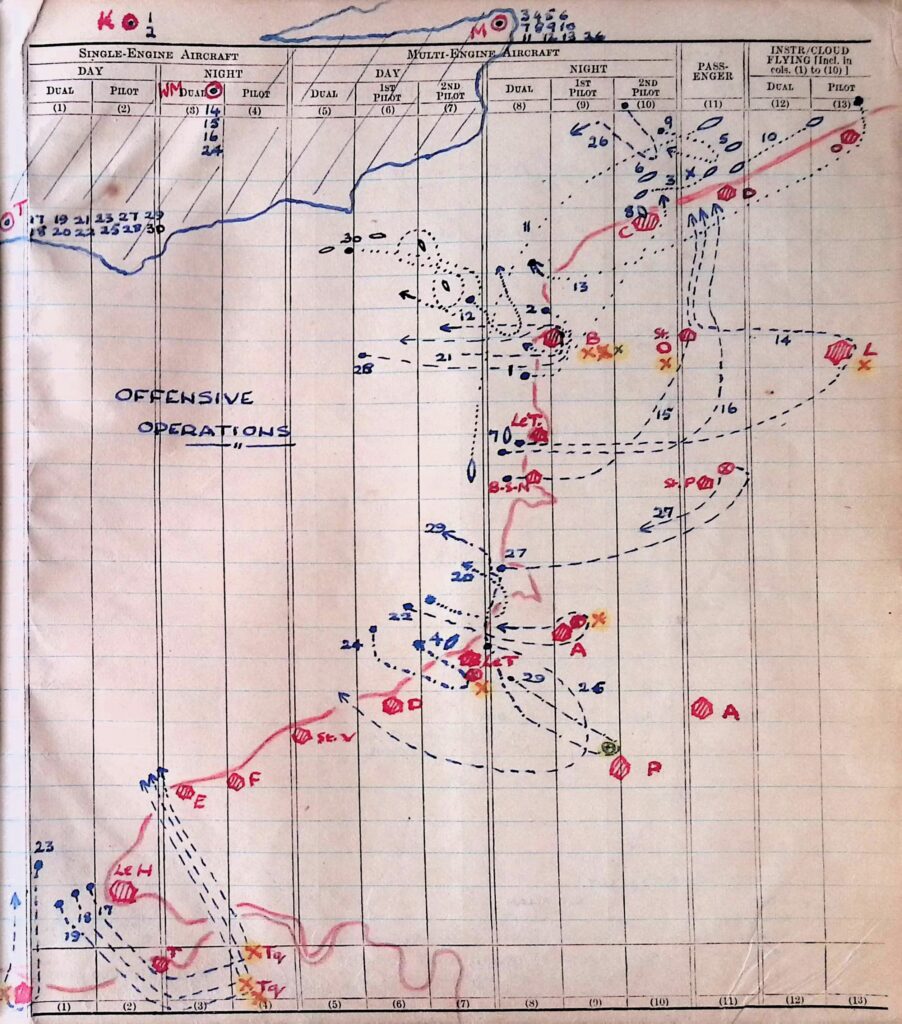
As a very experienced and successful pilot, Tim Elkington, even though away from 197 Squadron for significant periods on courses and attachments, contributed greatly to the Squadron’s growing expertise and success over the summer of 1943. Between March and September, he flew several offensive sorties on CIRCUS and RAMROD operations as well as RODEO fighter sweeps and numerous defensive sorties, including many standing patrols. Of particular note was his participation in three raids in April 1943, where 197 Squadron provided the close fighter escort to Typhoon ‘Bombphoons’ attacking a Luftwaffe airfield at Triqueville in Normandy, France. The airfield was so badly damaged that the Luftwaffe subsequently abandoned it. Other raids were to follow, attacking airfields and railway yards until, on September 9th, Tim Elkington flew his last sortie with 197 Squadron. This provided a rather unusual finale as the Squadron was flying naval escort patrols for Operation STARKEY, a simulated invasion of France near Boulogne intended to test the enemy’s response to such threats.
In September 1943, Tim Elkington was posted to 67 Squadron at Alipore, Calcutta, and in February 1944, on completing his tour with 67 Squadron, he was given early promotion to work at the Air Fighting Development Unit, based at RAF Amarda Road in north-east India, which played a crucial role in developing tactics and testing captured Japanese fighters. Returning to Britain in 1946, he served at RAF Turnhouse near Edinburgh and HQ Fighter Command before undertaking a tour in the MOD. Converting to the four-engined Shackleton maritime patrol aircraft in November 1955, Sqn Ldr Elkington joined 240 Squadron RAF based in Northern Ireland. In March 1956 he flew a Shackleton to Christmas Island in the Pacific for Operation Grapple, the testing of Britain’s first hydrogen bomb. The Shackletons, flying at a safe distance, ensured the area was clear before the Hydrogen bomb was dropped and provided air-sea rescue if needed.
Tim Elkington had a long post-war career in the RAF and retired on 23rd December 1975 as a Wing Commander.
Wg Cdr John Francis Durham ‘Tim’ Elkington RAF
Born December 23, 1920, died February 1, 2019
Research and text by L. K. Byrne. Many thanks to Gray Elkington for his assistance in preparing the story and to the Elkington family for the images.