
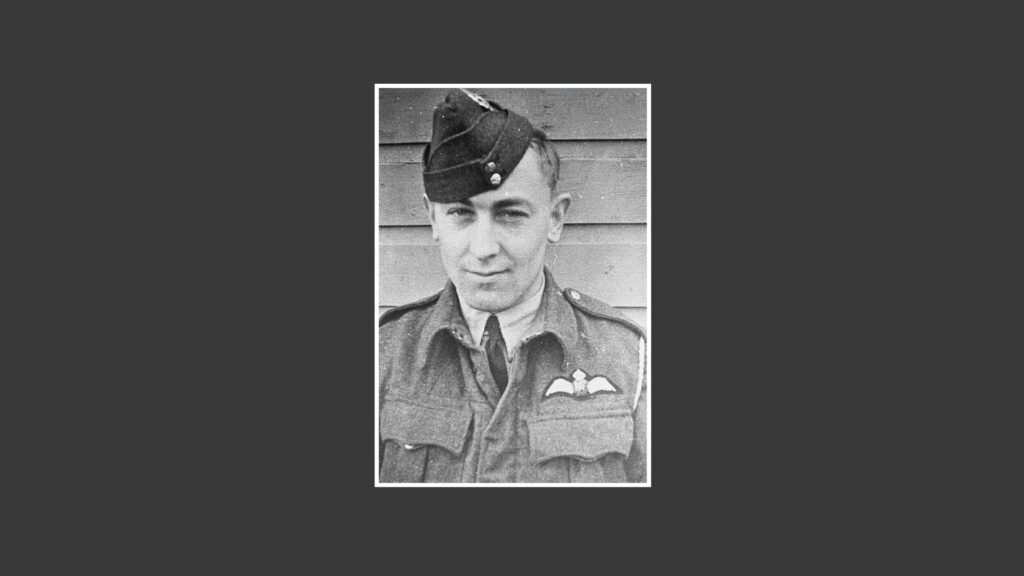
Sgt Ernest Henry Fletcher RAF
197 Squadron RAF December 23, 1942 – April 22, 1943
Ernest Fletcher was one of the very first pilots to join 197 Typhoon Squadron shortly before they flew their first operational sorties on 31 March 1942. Barely a year later, he was killed when his Typhoon aircraft crashed in a garden in Bognor Regis whilst returning in bad weather from a standing patrol. The cause of the crash was unknown.
Sergeant Ernest “Ern” Fletcher arrived at 197 Squadron from 55 Operational Training Unit (OTU) on December 23, 1942, the last step in a long journey that had commenced some 18 months before. Back in July 1941, Fletcher, then a 19-year-old motor mechanic living in Bexleyheath, volunteered and enlisted in the RAF. Selected for aircrew training, LAC Fletcher (Svc. No. 1336582) would have completed his basic training at an Initial Training Wing (ITW), possibly followed shortly thereafter by a few familiarisation flights on Tiger Moths at an Elementary Flying Training School (EFTS) before embarking for Canada and the USA.
Arriving in Canada in August / September 1941, Trainee Pilot Fletcher first travelled to Maxwell Air Force Base in Montgomery, Alabama, USA for reception and processing, joining Course SE 42F of the American-run Arnold Scheme.

Fletcher completed his primary flight training on Stearman PT 17 biplanes at Turner Field, Albany, Georgia, under the auspices of DARR Aerotech, a civilian flying school set up by Harold S Darr, then president of Braniff Airlines. Moving on, Fletcher, under the kindly direction of the USAAC, undertook his basic training on the Vultee BT 13 at Cochran Field, Macon, Georgia followed by advanced training on the North American ATC6 (known to the RAF as the Harvard) at Craig Field, Selma, Alabama before, finally, concluding his training with a gunnery course at Elgin Field, Valparaiso, Florida. He was awarded his pilot’s wings and promoted to Sergeant in June 1942. Sgt Ernest Fletcher then returned to the UK in late summer 1942.

After a short period of leave, Sgt Fletcher undertook a further 10 – 12 weeks of operational training at No 55 OTU in Annan, Dumfriesshire. Here, Fletcher would have been introduced to various RAF aircraft types, particularly the Hurricane and the latest operational and tactical developments – along with the British weather! On completion, he was posted to 197 Squadron RAF at RAF Drem in East Lothian, Scotland.
197 Squadron, equipped with the new Hawker Typhoon 1b, was a recently formed fighter squadron still in the process of working up. Sgt Fletcher would have converted to the Typhoon and subsequently flown with the Squadron on several training flights practising formation flying, low-flying cross-country, interceptions, air-to-air camera gun attacks and air-to-ground gun attacks. Between February 28 and March 3, 1943, he is known to have travelled to RAF Henlow to collect a new Typhoon from No. 13 Maintenance Unit (MU). At the end of March 1943, 197 Squadron, now declared operational, moved to RAF Tangmere in West Sussex. The Squadron flew its first operational sorties on 31 March 1943.
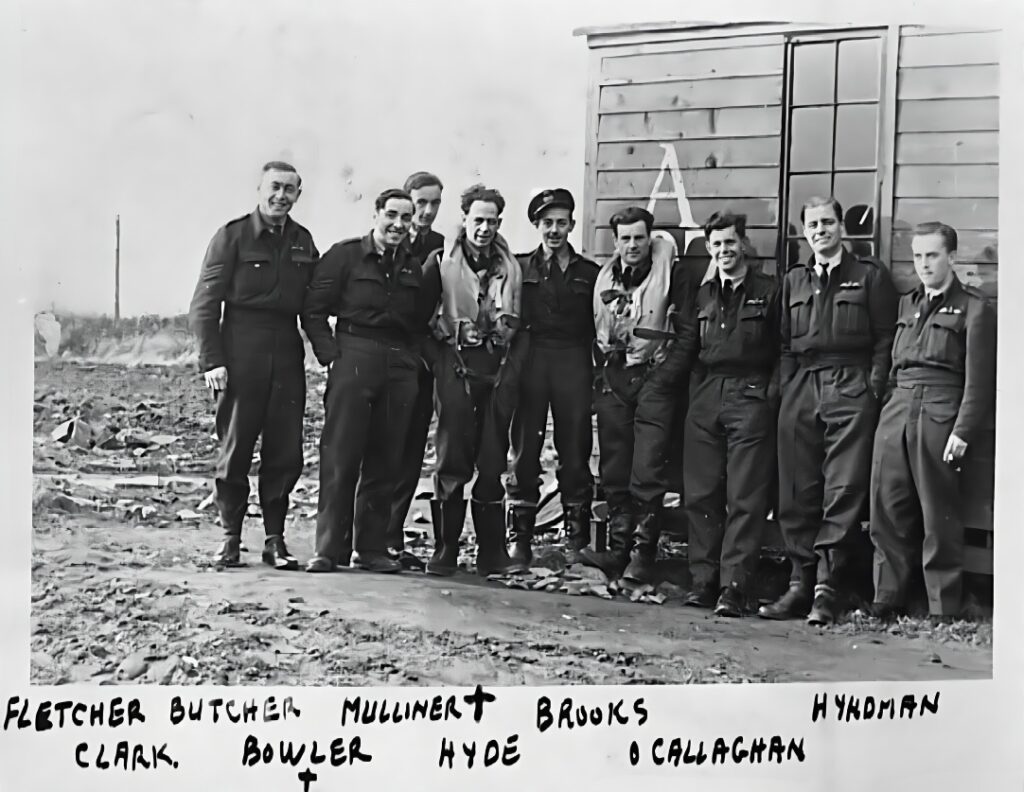
197 Squadron was tasked, at this time, to fly two-aircraft “Standing Patrols” between Selsey Bill and St. Catherine’s Point, the southern tip of the Isle of Wight, guarding the approaches up the Solent to Portsmouth from the Luftwaffe “Tip & Run” raiders that had been troubling the South Coast over the preceding few months. Sgt Fletcher flew ten such standing patrols between March 31 and April 13, 1943. On these patrols, the Squadron records show that he usually flew either Typhoon OV-J (S/N DN545) or Typhoon OV-G (S/N DN264). DN545/J was part of 197’s initial Typhoon equipment, received on January 27, 1943. A month later, on February 27, it was delivered to Scottish Aviation (Prestwick) for Mod 286 tail strengthening (all Typhoons underwent this mod between December 1942 and March 1943) and was returned on March 22, just before 197 Sqn left for Tangmere.
Following one week’s leave, in which he returned home to visit family, Sgt Fletcher flew two further patrols, both in OV-J, on April 21 and 22, 1943.
The 197 Squadron Operational Record Book (ORB) has the following entry for 22 April 1943:
“A bad day for the Squadron. Sgt Fletcher crashed in a garden in the suburbs of Bognor Regis when returning from a Standing Patrol at 08.30 hours. There was extremely bad weather at the time, and the cause of the crash cannot be stated with accuracy. The pilot was killed and his aircraft CAT E [written off]. Towards mid-day, the weather closed in entirely, and Standing Patrols were stopped for the rest of the day.”

That morning, P/O Ahrens and Sgt Fletcher had taken off to fly a routine standing patrol, the second of the day. No surviving accident report appears to exist, but the Form 1180 [accident summary card] notes “flicked and spun” for DN545. Though the exact cause is unknown, the spin may have arisen from too sharp a turn, from avoiding an obstruction, or from the very bad weather.

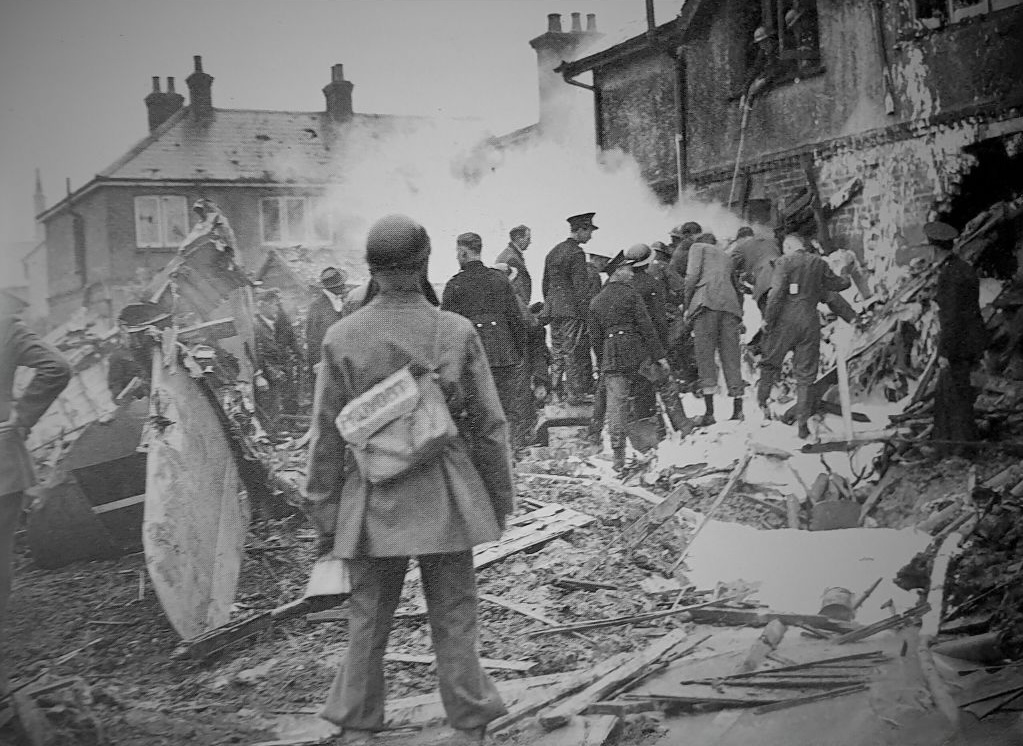
The incident was widely reported in the press. The Evening News for April 22 was one of these papers, reporting the crash under the column heading and sub-heading “Plane Crashes on a Bognor House” and “Man in garden and pilot killed”. The paper reports that “An RAF plane fell into the middle of Bognor Regis today” and that it “fell in a back garden in Beatty Road, and killed the owner, Mr Leonard Martlew, who was standing in the garden. The pilot, who was unable to bale out, was killed.
A column of flame rose 200 feet, and the wreckage blazed for 15 minutes. Parts of the plane were scattered over neighbouring gardens, and a section of the undercarriage was blown into a house 50 yards away. The occupant of this house, Miss Daisy Smith, was taken to hospital suffering from burns. The local N.F.S. extinguished the burning plane, which threatened surrounding houses. Sgt Fletcher was the son of James and Florence Fletcher of Abbey Wood.“
Poignantly, on the day of his fateful crash, Sgt Fletcher had sent a birthday card to his sister, Annie Marshall née Fletcher, who probably received it the day after he died.

Sgt Fletcher was buried on 28 April 1943 at Woolwich Cemetery, London. A Salvation Army memorial service for Ernest Henry Fletcher, a devout Christian and Salvation Army bandsman, followed on May 2, 1943. His grave has the following inscription: “How can I make a lesser sacrifice when Jesus gave his all? “
Howard Guiness, the Church of England Chaplain at RAF Tangmere, and a good friend of Ernest, wrote the following to Sgt Fletcher’s mother:
“Our deepest sympathy comes to you from the bottom of our hearts – hearts which are sorrowing and yet proud. The whole squadron is proud of him. I have heard from both officers and Sergt. Pilots the same thing: he was always thinking of others, always lending a helping hand, always a fine example of what a Christian gentleman should be, and an exceptionally good pilot. They are all agreed that if anyone was ready for the great call, he was.”
Sergeant Ernest Henry Fletcher RAF (1336582)
Born August 17, 1921; died April 22, 1943.
Research and text by L.K. Byrne. Sources: 197 Squadron Operations Record Book, AIR27/1169, The National Archives, UK.; 350sqn-raf.be (by kind permission of Sorge Bonge); The Frank L’Alouette Collection courtesy of Mrs Jeanette Hickman [LAL1447], The British Newspaper Archive, West Sussex County Council; all in conjunction with and by the kind permission of the Marshall Family Collection. The family’s own research contributed to the development of this article.